Hanuman’s Childhood and Curse
This narrative explores young Hanuman's playful yet powerful nature, his inadvertent act of mistaking the sun for a fruit, the subsequent curse that made him forget his powers, and the eventual circumstances under which he was reminded of his divine capabilities.
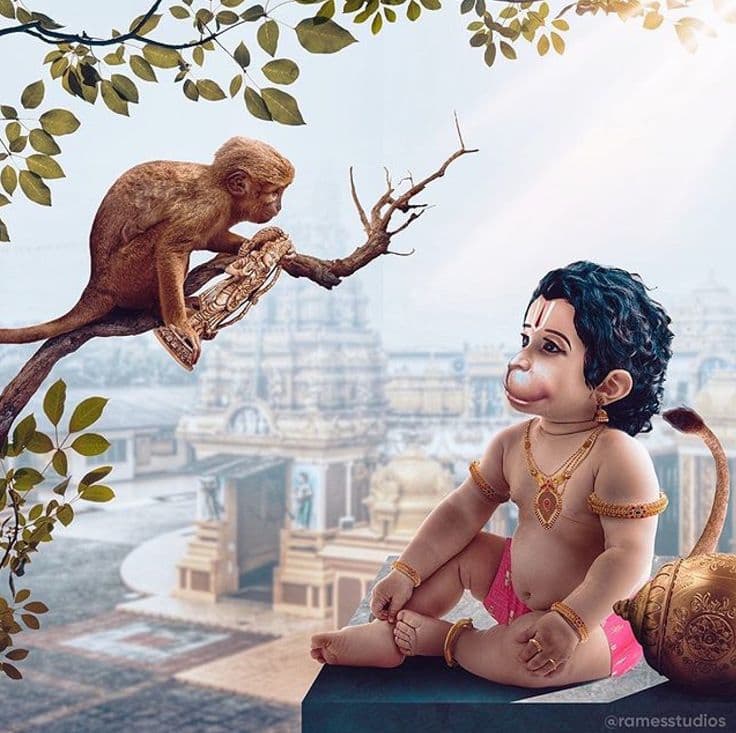
Hanuman’s Childhood and Curse
Date
Mythological Time Period (Childhood of Hanuman)
Location
Various locations in Hindu mythology, including forests and celestial realms.
- Hanuman (Child)Divine Child, Mischief Maker
As a child, Hanuman was imbued with immense energy and a playful spirit. His actions, though sometimes disruptive, often stemmed from curiosity and divine Lila (play).
- Surya (Sun God)Celestial Body
The Sun, mistaken by young Hanuman for a ripe fruit due to its radiant glow.
- IndraKing of Gods
Intervened when Hanuman leaped for the sun, striking him with his Vajra (thunderbolt), leading to Vayu's anger.
- Vayu (Wind God)Spiritual Father
Hanuman's spiritual father, who withdrew air from the world in anger after Hanuman was struck.
- Sages (e.g., Sage Durvasa in some versions)Ascetics, Bestowers of Curse/Boons
In some accounts, Hanuman's youthful pranks disturbed meditating sages, leading to a curse limiting his memory of his powers.
- Step 1: Young Hanuman, driven by hunger and curiosity, sees the rising sun and mistakes it for a luscious fruit.
- Step 2: He leaps towards the sun with his divine strength, intending to grab and eat it.
- Step 3: Indra, concerned for the celestial order (or the sun itself), hurls his Vajra (thunderbolt) at Hanuman, striking his jaw (Hanu), which gives him his name.
- Step 4: Hanuman falls to earth. His father, Vayu (Wind God), enraged, withdraws air from the world, causing immense suffering.
- Step 5: The gods, led by Brahma and Shiva, appease Vayu and revive Hanuman. They bestow numerous boons upon him, making him immensely powerful and immortal.
- Step 6: In some versions, due to later playful disturbances to sages (like Sage Durvasa), Hanuman is cursed to forget his powers until reminded at an appropriate time by someone else (like Jambavan before the Lanka leap).
Core Idea
The event demonstrates Hanuman's divine origins, innate power even as a child, and sets the stage for his later role where his forgotten powers are crucial.
Moral Lesson
It teaches about the responsible use of power, the consequences of actions (even if innocent), and the importance of divine grace and timely reminders of one's potential. It also highlights that even divine beings undergo trials and phases of unawareness.
Playfulness
Hanuman's attempt to eat the sun symbolizes divine Lila (play) and the boundless energy of a divine child, unconstrained by ordinary limitations.
Curse And Reminder
The curse (in versions where it occurs for pranks) and the eventual reminder of his powers symbolize the veiling of divine potential by Maya (illusion) or circumstance, and its reawakening through guidance or need. The jaw injury (Hanu-man) is a permanent mark of this childhood adventure.
Spiritual Impact
This story is often told to illustrate Hanuman's extraordinary birth and the divine blessings that made him invincible. It reinforces faith in his protective powers and his ability to overcome any obstacle.
Cultural Impact
It's a popular Puranic tale that endears Hanuman to devotees, showcasing his unique journey from a playful child to a mighty hero. The incident also explains his name and his connection to various deities.