Hanuman Leela

Burning of Lanka

After successfully finding Sita in Lanka and delivering Rama’s message, Hanuman allows himself to be captured by Ravana’s forces to assess the enemy's strength. As punishment, Ravana orders his tail to be set on fire. Hanuman escapes, using the burning tail to set fire to large parts of Lanka, demonstrating his divine might and spreading terror among the rakshasas.
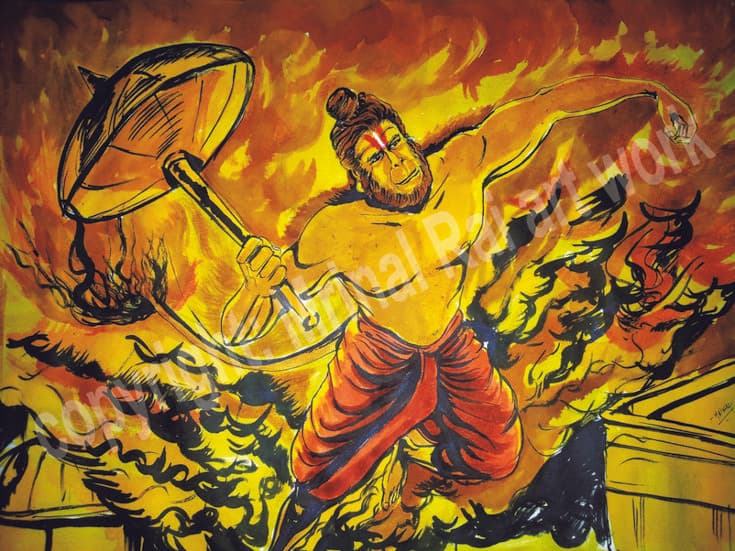
Burning of Lanka

Burning of Lanka

Event Overview

Date

Treta Yuga (Mythological Time Period)

Location

Lanka (modern-day Sri Lanka)

Key Characters / Deities
  • Hanuman
    Messenger and Warrior

    As Rama’s messenger, Hanuman fearlessly enters Lanka, finds Sita, delivers Rama’s ring and message, gets captured, and retaliates by burning down parts of Lanka with his fiery tail.

  • Sita
    Wife of Rama, Captive of Ravana

    Sita is discovered in the Ashoka Vatika garden, where Hanuman gives her hope and assurance of Rama’s rescue.

  • Ravana
    King of Lanka, Antagonist

    After hearing of Hanuman's intrusion, Ravana orders his execution, which is changed to the burning of Hanuman’s tail upon counsel from his ministers.

  • Vibhishana
    Ravana’s Brother and Wise Counselor

    Vibhishana advises Ravana against killing a messenger, resulting in the alternative punishment of burning Hanuman’s tail.

Sequence of Events / Typical Observance
  1. Step 1: Hanuman enters Lanka, searches for Sita, and finds her in the Ashoka Vatika.
  2. Step 2: He gives Sita Rama’s ring and assures her that Rama will come to rescue her.
  3. Step 3: After causing havoc in the royal gardens and killing some rakshasas, Hanuman allows himself to be captured to assess Ravana’s court.
  4. Step 4: Ravana orders his tail to be set on fire as punishment. The rakshasas wrap it in cloth and oil and set it ablaze.
  5. Step 5: With his burning tail, Hanuman escapes from his bonds and leaps across the city, setting fire to homes, buildings, and fortresses.
  6. Step 6: After burning Lanka, Hanuman leaps back across the ocean to return to Rama with the news about Sita and Lanka’s layout.
Significance

Core Idea

The burning of Lanka is a symbolic act of divine power unleashed against evil and injustice.

Moral Lesson

Devotion and fearlessness in the face of danger lead to the triumph of righteousness. Even a single devotee can shake the foundations of evil when empowered by faith and dharma.

Symbolism

Burning Tail

Represents divine wrath and justice. Though Hanuman is a peaceful messenger, he is also an unstoppable force when dharma is challenged.

Lanka In Flames

Symbolizes the impending fall of arrogance, ego, and unrighteousness represented by Ravana and his kingdom.

Impact

Spiritual Impact

Demonstrates Hanuman’s dual nature as both a humble servant and a fierce warrior, reinforcing his role as an extension of divine will.

Cultural Impact

This episode is dramatically portrayed in Ram Leela performances, literature, and temple murals; it is celebrated as a moment of heroic defiance and righteous fury.